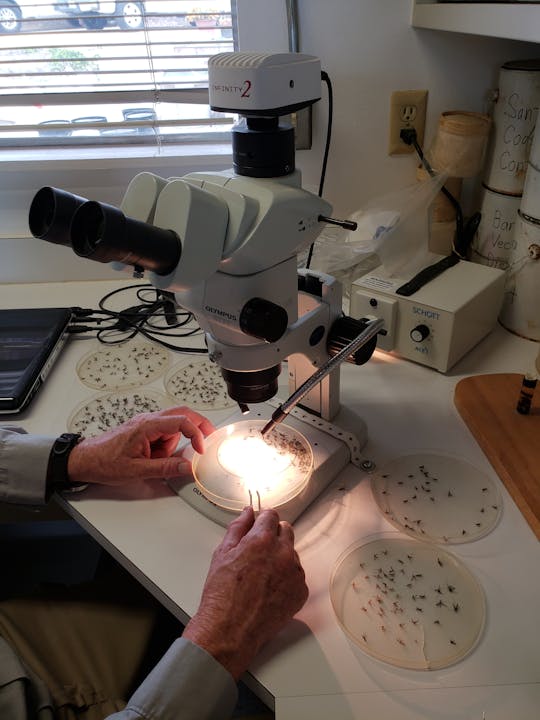
The purpose of the District is to provide vector surveillance, prevention, abatement, and control services to property owners and residents within the service area of the District to ensure their protection from vector annoyance and vector-borne diseases, such as St. Louis Encephalitis, Western Equine Encephalomyelitis, West Nile Virus, Malaria, Lyme Disease, Hanta Virus Pulmonary Syndrome, and Sylvatic Plague. To fulfill this purpose, the Board may utilize any and all of the scientifically accepted methods for the control of mosquitoes, flies, rodents, or other vectors within the District boundaries or its sphere of influence to protect the public from the threat of vector-borne disease.

Treatment and Control
Strategically, the District addresses vectors through a comprehensive approach, which is based upon effective prevention of vectors. The District controls mosquitoes through a program of integrated vector management (IVM). This program focuses on controlling mosquitoes in their larval stage, and preventing problems before the mosquito pupae hatch and have the ability to transmit diseases. Larval control has many benefits:

Less toxic: Often, mosquitofish and other environmentally safe approaches can be used. When needed, the bacterial agents or pesticides used to control the larval stage are much less toxic to the environment than those used in the past and are highly specific to mosquitoes.

Less pesticides: The bacterial agents or pesticides are applied to a smaller area than would be required for treatment of adult mosquitoes.

Less disease: Targeting immature mosquitoes kills them before they are capable of transmitting disease.

The end result is a program that protects public health, is more cost effective than other methods, and has low impact on the environment. The District uses biorational materials such as VectoBac (Bacillus thuringensis israelensis) and VectoLex (Bacillus sphaericus). Also used is the product Altosid (methoprene) which is an insect growth regulator. These materials have been shown to have minimal effects on non-target species and are regulated by the US EPA and the California Department of Pesticide Regulation. They are approved for use in aquatic habitats.

In addition to its mosquito abatement and vector control services, the District provides education programs on vectors and disease prevention at school and civic group meetings. The District maintains a website and distributes printed material and brochures that describe what citizens can do to keep their homes and property free of rats, yellow jackets, mosquitoes, and other pests.